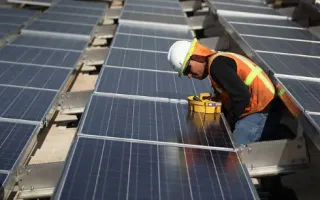
Buying solar panels can significantly reduce electricity expenses over time, but the upfront cost of a residential solar system can be substantial.
For homeowners who do not want to pay thousands of dollars in cash, a solar loan can provide a way to spread the cost across several years while retaining ownership of the system.
However, choosing a solar loan is not simply about finding the lowest advertised interest rate. The loan term, fees, monthly payment, total repayment, credit requirements, collateral, and early repayment conditions can all affect the actual cost of the solar investment.
In 2026, homeowners should evaluate solar financing as carefully as they evaluate the panels and inverter themselves.
What Is a Solar Loan?
A solar loan is financing specifically used to pay for a solar energy system or, in some cases, a broader home improvement project that includes solar.
Unlike a solar lease or power purchase agreement, a homeowner using a solar loan generally owns the solar equipment after purchasing it.
The basic structure is straightforward:
Solar installation cost → Loan financing → Monthly payments → Homeowner owns the system
For example:
- Solar installation: $20,000
- Down payment: $3,000
- Loan amount: $17,000
- Loan term: 10 years
- Monthly payments: determined by the interest rate and loan terms
The homeowner then uses the electricity generated by the system while making payments to the lender.
How Solar Loan Interest Rates Work
The interest rate is one of the most important factors in determining the total cost of solar financing.
A lower interest rate generally means less interest paid over the life of the loan, assuming the other terms are comparable.
However, homeowners should look at the annual percentage rate (APR) rather than focusing exclusively on a headline interest rate.
APR can provide a more useful picture of borrowing costs because certain financing fees may be incorporated into the calculation.
Fixed vs. Variable Solar Loan Rates
Solar loans can have either fixed or variable interest structures.
Fixed-rate loan: The interest rate generally remains unchanged throughout the agreed term.
Variable-rate loan: The interest rate can change according to the terms of the financing agreement.
For long-term home improvements, predictable payments can make budgeting easier, which is one reason homeowners often pay close attention to fixed-rate financing.
Solar Loan Terms and Monthly Payments
Loan term refers to the amount of time available to repay the financing.
Common structures can range from several years to longer periods, depending on the lender and financing product.
Consider this simplified example:
| Loan Amount | Term | Illustrative APR | Approx. Monthly Payment* |
|---|---|---|---|
| $15,000 | 5 years | 7% | $297 |
| $15,000 | 10 years | 7% | $174 |
| $15,000 | 15 years | 7% | $135 |
| $15,000 | 20 years | 7% | $116 |
*Illustrative principal-and-interest calculations. Actual offers, fees, and payments vary by lender.
A longer loan term can make the monthly payment more affordable, but it usually increases the amount of interest paid over time.
Short-Term vs. Long-Term Solar Loans
A shorter loan can provide:
- Higher monthly payments
- Lower total interest
- Faster debt repayment
- Potentially faster financial break-even
A longer loan can provide:
- Lower monthly payments
- Higher total interest
- Longer repayment period
- More flexibility for monthly cash flow
Homeowners should choose based on total financial capacity rather than selecting the longest term simply because it produces the smallest monthly payment.
Solar Loan Fees You Should Check
Interest is not necessarily the only cost associated with solar financing.
A loan agreement may include different fees depending on the lender and financing structure.
Potential costs can include:
- Origination fees
- Application fees
- Administrative fees
- Dealer or contractor financing fees
- Documentation fees
- Late-payment charges
- Prepayment-related fees
Some financing arrangements may advertise a low interest rate while incorporating substantial fees elsewhere in the transaction.
Why Origination Fees Matter
Suppose a homeowner sees two financing options.
Loan A
- Advertised rate: 6.5%
- Origination fee: $1,500
Loan B
- Advertised rate: 7.0%
- Origination fee: $300
The lower interest rate does not automatically mean Loan A is cheaper.
The homeowner should compare the APR and total repayment, not just the advertised rate.
Solar Loan Qualification Requirements
Lenders generally evaluate the borrower's ability to repay the loan.
Qualification criteria can vary, but lenders may consider:
- Credit history
- Credit score
- Income
- Existing debt
- Debt-to-income ratio
- Employment history
- Payment history
- Loan amount
- Property information
A stronger credit profile may provide access to more competitive financing terms.
Credit Score and Solar Financing
There is no single credit-score requirement that applies to every solar loan.
Different lenders use different underwriting standards.
A homeowner with excellent credit may qualify for more favorable rates, while a borrower with weaker credit may face:
- Higher interest rates
- Higher fees
- Larger down-payment requirements
- Lower borrowing limits
- Fewer available financing options
Homeowners should avoid applying for numerous loans simultaneously without understanding whether the applications will involve hard credit inquiries.
Debt-to-Income Ratio and Solar Loans
Lenders may evaluate how much existing debt a homeowner carries compared with income.
A simplified debt-to-income calculation is:
Monthly debt payments ÷ Gross monthly income × 100
For example:
- Monthly debt payments: $1,500
- Gross monthly income: $5,000
$1,500 ÷ $5,000 × 100 = 30%
Adding a solar loan payment could increase the homeowner's debt obligations.
A homeowner should therefore consider the new monthly payment alongside mortgage, auto loans, credit cards, student loans, and other financial commitments.
Example: Calculating the Total Cost of a Solar Loan
Suppose a homeowner needs:
$20,000
for a solar installation.
Assume the financing terms are:
- Loan amount: $20,000
- APR: 7%
- Term: 10 years
- No additional fees for this example
The approximate monthly payment would be around:
$232 per month
Over 120 months:
$232 × 120 = $27,840
The simplified financing cost would therefore be approximately:
$27,840 − $20,000 = $7,840
This demonstrates why homeowners should calculate total repayment rather than focusing only on the monthly payment.
If the solar system saves approximately $2,400 per year:
$2,400 ÷ 12 = $200 monthly savings
The homeowner would still have a financing payment of approximately $232 per month during the loan term.
That does not automatically mean the project is a bad investment, because the homeowner is also building ownership in the solar equipment. However, it shows why cash flow and long-term ROI are separate calculations.
Solar Loan vs. Cash Purchase
A homeowner with enough savings may compare financing with paying cash.
| Factor | Cash Purchase | Solar Loan |
| Upfront cost | High | Lower |
| Interest | None | Yes |
| Monthly payment | None | Yes |
| System ownership | Yes | Yes |
| Emergency cash preserved | Lower | Higher |
| Total financing cost | Lowest | Higher |
| Financial flexibility | Lower initially | Higher initially |
Cash can minimize the total project cost, but using a large portion of available savings can reduce financial flexibility.
A solar loan can preserve cash while increasing total project costs.
The better choice depends on the homeowner's financial situation.
Solar Loan vs. Lease and PPA
A solar loan provides a fundamentally different ownership structure from a lease or PPA.
| Feature | Solar Loan | Solar Lease | Solar PPA |
| Homeowner owns system | Usually yes | Usually no | Usually no |
| Monthly payment | Loan payment | Lease payment | Energy-based payment |
| Interest | Usually yes | Not structured as loan interest | Not structured as loan interest |
| Maintenance | Owner responsibility varies | Usually provider | Usually provider |
| Long-term ownership | Yes | Usually provider | Usually provider |
| Home sale considerations | Loan payoff/transfer | Contract transfer | Contract transfer |
Homeowners should compare these options based on the full contract rather than assuming one structure is automatically better.
Solar Loans and Home Equity
Some homeowners may consider financing solar through home equity products rather than a dedicated solar loan.
Potential options can include:
- Home equity loans
- Home equity lines of credit
- Personal loans
- Specialized solar financing
Each option has different interest rates, fees, repayment structures, and risks.
Homeowners should pay particular attention to whether the financing is secured against the property.
A secured loan can potentially offer a lower interest rate, but the property may be exposed to greater consequences if the borrower cannot repay the debt.
Solar Financing Considerations in the United States
US homeowners have access to a wide range of solar financing products, but availability and terms vary by state, lender, installer, and borrower.
The former federal Residential Clean Energy Credit also needs careful consideration when calculating the economics of a new 2026 installation. The residential credit under Section 25D does not apply to expenditures after December 31, 2025.
Therefore, homeowners should not reduce a 2026 solar loan calculation by automatically assuming a 30% federal residential tax credit.
California
Compare solar financing with utility rates, export compensation, and battery economics. A higher loan payment may be difficult to justify if the system's electricity savings are lower than expected.
Texas
Review the specific electricity plan and export compensation available at the property. Solar savings can differ considerably between utility territories.
Florida
Check the roof condition before financing a long-term solar project. Financing solar on a roof that needs replacement can create another major expense later.
New York
Check current state and utility incentives before deciding how much of the project should be financed.
Solar Loans in the United Kingdom
UK homeowners should compare financing costs with expected electricity savings and potential export income.
The financial model should include:
- Loan principal
- Interest
- Financing fees
- Solar production
- Electricity savings
- Export payments
- Battery costs
The Smart Export Guarantee can provide eligible generators with payments for exported electricity through participating suppliers.
However, the value of exported electricity may differ from the value of electricity consumed directly in the home.
Solar Loans in Canada
Canadian homeowners should investigate financing at the provincial and utility level.
Available financing and incentives can differ between provinces.
Before accepting a solar loan, compare:
Loan repayment + fees
against:
Expected electricity savings + applicable incentives
A longer loan term may make monthly payments easier but can increase the total cost of borrowing.
Solar Loans in the Netherlands
Dutch homeowners should consider the upcoming change to electricity-export economics.
The salderingsregeling ends from January 1, 2027, which makes household self-consumption increasingly important.
When evaluating a solar loan, homeowners should model expected savings under the post-2027 environment rather than relying exclusively on historical electricity-bill reductions.
A household that can consume more solar electricity during daylight hours may achieve a different financial result from one that exports most of its production.
Solar Loans in Australia
Australian homeowners can compare personal financing, solar-specific financing, and other home improvement lending options.
For households adding battery storage, the federal Cheaper Home Batteries Program can affect the upfront battery cost for eligible systems.
However, homeowners should still calculate:
Total financed cost − expected long-term energy savings
rather than assuming that a rebate automatically makes every financing option financially attractive.
How to Get the Best Solar Loan
Compare Multiple Lenders
Do not assume the installer offers the cheapest financing.
Compare several financing offers when possible.
Look at APR
An advertised interest rate can hide additional financing costs.
APR provides a more useful comparison when evaluating different loan products.
Calculate Total Repayment
Always multiply the monthly payment by the number of payments and add applicable upfront fees.
This reveals the approximate amount you will actually spend.
Avoid Choosing Based Only on Monthly Payment
A low monthly payment can be achieved by extending the loan term.
That can increase total interest substantially.
Check Prepayment Conditions
If you expect to pay the loan early, make sure you understand whether there are penalties, fees, or other restrictions.
Understand Dealer Fees
Some solar financing structures can include significant fees associated with the installation company or financing arrangement.
Ask for a complete written breakdown.
Solar Loan Red Flags
Homeowners should be cautious when a financing offer:
- Focuses exclusively on monthly payment
- Does not clearly disclose APR
- Hides significant fees
- Uses complicated escalation clauses
- Pressures the homeowner to sign immediately
- Provides unclear early-payment terms
- Does not explain total repayment
- Makes unrealistic savings promises
A reputable financing proposal should make the total financial obligation understandable before the homeowner signs.
FAQ
What is a solar loan?
A solar loan is financing used to purchase a solar energy system. Unlike a lease or PPA, the homeowner generally owns the solar equipment.
What credit score do I need for a solar loan?
There is no universal minimum. Requirements vary by lender, loan type, amount borrowed, income, debt obligations, and overall credit profile.
Are solar loans tax deductible?
The tax treatment depends on the financing structure and the homeowner's circumstances. Borrowers should consult a qualified tax professional before assuming that solar-loan interest is deductible.
How long are solar loans?
Terms vary by lender and product. Some solar loans can extend for many years, allowing homeowners to reduce monthly payments while potentially increasing total interest costs.
Is a solar loan better than paying cash?
Not necessarily. Cash can minimize financing costs, while a loan preserves more cash upfront. The better option depends on liquidity, investment alternatives, loan terms, and expected solar savings.
Can I pay off a solar loan early?
Many loans allow early repayment, but homeowners should review the specific agreement for prepayment penalties or other conditions.
Does solar financing affect my credit?
Applying for and maintaining a loan can affect a homeowner's credit profile. The exact impact depends on the lender, application process, payment history, and credit-reporting practices.
Should I finance solar panels for 20 years?
A long loan term can lower monthly payments but increase total interest. Compare the total repayment against shorter loan options before choosing a 20-year structure.
Conclusion
Solar loans can make residential solar more accessible by allowing homeowners to spread the cost of installation over time.
However, the lowest monthly payment is not necessarily the best financing deal.
Before choosing a solar loan, evaluate:
APR + loan term + fees + monthly payment + total repayment + ownership + expected solar savings
A homeowner should also compare solar financing with paying cash, leasing, and PPAs.
For a large home improvement investment, understanding the financing contract can be just as important as selecting the solar panels themselves.
Regional factors also matter. Homeowners in the United States, United Kingdom, Canada, Netherlands, and Australia face different electricity prices, incentive structures, export rules, and financing environments.
Before signing a solar loan, request a complete written financing proposal, compare multiple offers, calculate the total repayment, and make sure the expected long-term solar savings realistically justify the cost of borrowing.
Ready to finance your solar installation? Start by comparing at least three financing options and focus on total cost—not just the advertised monthly payment or interest rate.