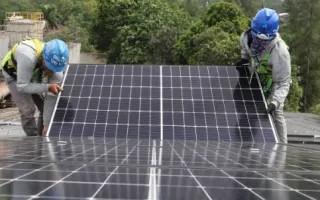
For many businesses, the biggest obstacle to installing solar panels is not whether solar energy can reduce electricity costs. It is finding the right way to finance the project.
A commercial solar installation can require an investment ranging from tens of thousands of dollars to more than one million dollars for large facilities.
Paying the entire amount in cash may not be practical for every company. On the other hand, choosing a financing arrangement with expensive interest or unfavorable contractual terms can reduce the project's long-term financial benefit.
This makes commercial solar financing one of the most important decisions business owners must evaluate before signing a solar contract.
Businesses can consider several structures, including commercial solar loans, equipment financing, leases, power purchase agreements, and cash purchases.
Tax incentives and depreciation benefits can also significantly affect the project's final economics.
The best strategy depends on the company's cash flow, tax position, electricity consumption, property ownership, risk tolerance, and long-term plans.
What Is Commercial Solar Financing?
Commercial solar financing refers to the methods businesses use to pay for solar equipment, installation, engineering, electrical work, and related project expenses.
Instead of paying the entire installation cost immediately, a business can structure payments over several years.
Common options include:
- Commercial solar loans
- Equipment financing
- Solar leases
- Power purchase agreements
- Cash purchases
- Specialized clean-energy financing
Each option creates a different relationship between the business, solar equipment, lender, and installer.
The most important distinction is who owns the solar system.
When the business owns the equipment, it may receive certain ownership-related financial benefits.
With a lease or PPA, a third party may own the system while the business pays for the use of the equipment or the electricity it produces.
Commercial Solar Financing Options Compared
| Financing Option | Equipment Owner | Upfront Cost | Long-Term Control | Potential Tax Benefits |
|---|---|---|---|---|
| Cash purchase | Business | High | High | Potentially strong |
| Solar loan | Business | Low–Medium | High | Potentially strong |
| Equipment financing | Business | Low–Medium | High | Potentially strong |
| Solar lease | Third party | Low | Medium | Usually different |
| PPA | Third party | Very low | Lower | Generally benefits owner |
| Specialized financing | Varies | Varies | Varies | Depends on structure |
Tax treatment varies by country, business structure, eligibility, and project ownership.
Therefore, businesses should have their accountant or tax professional review the specific transaction.
Commercial Solar Loans
A commercial solar loan allows a business to borrow money to purchase and install the solar system.
The company generally owns the equipment while making scheduled payments to the lender.
Advantages of Solar Loans
Potential benefits include:
- Asset ownership
- Low upfront capital requirement
- Potential tax benefits
- Potential depreciation benefits
- Long-term electricity savings
- Greater control over the system
The main disadvantage is interest expense.
A project that costs $300,000 in cash could cost substantially more over time if financed at a high interest rate.
What Should Businesses Compare?
Don't compare loans only by monthly payment.
Review:
- Interest rate
- Loan term
- Origination fees
- Closing costs
- Prepayment penalties
- Collateral requirements
- Total repayment
- Payment schedule
The total amount repaid is often more important than the advertised monthly payment.
Commercial Equipment Financing
Equipment financing can be structured specifically around the solar installation.
The solar equipment itself may serve as part of the financing structure, depending on the lender and transaction.
For businesses that want to preserve working capital while owning the system, equipment financing can be an alternative to traditional business loans.
The company should compare the total financing cost with the expected annual solar savings.
Solar Lease for Businesses
Under a commercial solar lease, a third-party company generally owns the solar equipment.
The business makes scheduled lease payments for the use of the system.
The main attraction is reducing the upfront capital requirement.
However, businesses should carefully examine:
- Lease duration
- Annual payment increases
- Maintenance responsibility
- Equipment ownership
- Early termination terms
- Property sale requirements
- End-of-term options
A low monthly payment does not automatically mean the lease is financially superior.
Commercial Solar Power Purchase Agreement
A Power Purchase Agreement, commonly called a PPA, is another financing structure.
Under a PPA, a third-party provider typically owns the solar system and sells the electricity generated by that system to the business at an agreed price.
Instead of purchasing the solar equipment, the business purchases electricity.
This can reduce upfront capital requirements.
Why Businesses Consider PPAs
PPAs can be attractive when a company wants:
- Minimal upfront investment
- Predictable electricity pricing
- Third-party system ownership
- Reduced operational responsibility
However, businesses should carefully review the contract's electricity price, escalation mechanism, contract length, production assumptions, and termination provisions.
Cash Purchase vs. Financing
A cash purchase provides maximum ownership but requires substantial capital.
Consider a hypothetical project:
Commercial solar installation: $300,000
Suppose the system generates annual electricity savings of:
$45,000
Simple payback:
$300,000 ÷ $45,000 = 6.67 years
If the business pays cash, the project can potentially begin generating net savings after the initial investment has been recovered.
Now consider financing.
Suppose total loan repayment over the entire term is:
$375,000
The financing adds:
$375,000 − $300,000 = $75,000
The business must therefore consider whether preserving $300,000 in working capital is worth the additional financing cost.
This is fundamentally a capital allocation decision.
Commercial Solar Tax Incentives
Tax incentives can dramatically change the economics of a commercial solar project.
Depending on the jurisdiction and business structure, incentives may include:
- Investment tax credits
- Accelerated depreciation
- Rebates
- Grants
- Renewable energy certificates
- State or provincial incentives
- Local utility programs
In the United States, qualifying commercial solar projects may benefit from federal clean-energy tax incentives and accelerated depreciation under applicable rules.
Eligibility can depend on project timing, ownership, technology, tax status, and other requirements.
Businesses should not treat a tax incentive as guaranteed until eligibility has been verified for the specific project.
Example: Tax Incentive Impact
Consider a hypothetical commercial solar project costing:
$500,000
Assume the business qualifies for a hypothetical incentive worth:
30%
Potential incentive value:
$500,000 × 30% = $150,000
Illustrative net investment:
$500,000 − $150,000 = $350,000
If annual net savings are:
$60,000
Simplified payback becomes:
$350,000 ÷ $60,000 = 5.83 years
Without the incentive:
$500,000 ÷ $60,000 = 8.33 years
This example demonstrates why incentives can materially change the project's financial return.
Actual incentive calculations must be based on current rules and the specific project.
Commercial Solar ROI Calculation
ROI should consider the total investment and cumulative financial benefits.
A simplified formula is:
ROI = (Total Benefits − Total Investment) ÷ Total Investment × 100
Suppose:
Net investment: $350,000
Cumulative net savings over 10 years: $550,000
Estimated profit from savings:
$550,000 − $350,000 = $200,000
Simplified ROI:
$200,000 ÷ $350,000 × 100 = 57.1%
This is a simplified calculation.
A professional investment analysis should also consider the time value of money, degradation, maintenance, financing costs, taxes, and residual equipment value.
Commercial Solar Payback Period
The payback period indicates how long it takes for cumulative savings to recover the initial investment.
A simplified calculation is:
Net Investment ÷ Annual Net Savings
For example:
$400,000 ÷ $65,000 = 6.15 years
The project has a simplified payback period of approximately 6.2 years.
Businesses should be cautious when comparing payback claims because installers may use different assumptions.
Always ask what is included in the calculation.
Why Electricity Rates Matter
Electricity prices have a major impact on commercial solar ROI.
Suppose a business uses:
500,000 kWh/year
If electricity costs:
$0.15/kWh
Annual electricity expense:
500,000 × $0.15 = $75,000
If the effective electricity cost rises to:
$0.20/kWh
Annual expense becomes:
500,000 × $0.20 = $100,000
The additional $25,000 of annual electricity expense increases the potential value of solar energy.
Businesses with high electricity rates can therefore have stronger solar economics.
Demand Charges and Commercial Solar
Commercial electricity bills may include demand charges.
A demand charge can be based on the highest level of electricity demand during a billing period.
Solar can potentially reduce some daytime demand, depending on system design and the business's load profile.
Battery storage may provide additional demand management opportunities.
For businesses with substantial demand charges, solar financial analysis should evaluate both:
Energy savings
and
Demand savings
Ignoring demand charges can produce an incomplete ROI calculation.
Commercial Solar Battery Financing
Some businesses may combine solar panels with battery storage.
A battery can potentially provide value through:
- Peak demand reduction
- Time-of-use energy shifting
- Backup power
- Increased solar self-consumption
- Energy arbitrage
However, batteries increase project cost.
Suppose:
Solar system: $350,000
Battery system: $100,000
Total investment:
$450,000
If the battery produces only limited additional annual savings, the combined project may have a weaker ROI than solar alone.
Businesses should therefore calculate the incremental value of the battery separately.
Commercial Solar Financing in the United States
US businesses should evaluate federal incentives alongside state and utility programs.
California
Businesses may face significant electricity costs and demand charges.
Solar financing should therefore consider both energy savings and potential demand-related benefits.
Texas
Commercial solar economics depend heavily on electricity contracts, utility structures, system size, and project location.
Businesses should carefully model electricity purchases and any exported generation.
Florida
Strong solar resources can support commercial projects, but businesses should also evaluate roof conditions, insurance considerations, weather resilience, and financing costs.
New York
Businesses should examine available state and utility incentives, electricity prices, and financing programs when calculating project ROI.
Commercial Solar Financing in the United Kingdom
UK businesses should compare:
- Commercial electricity rates
- Solar production
- Export income
- Financing interest
- Installation costs
- Business energy contracts
- Tax treatment
Businesses with high daytime electricity consumption can potentially improve project economics by consuming solar generation directly.
Commercial Solar Financing in Canada
Canadian businesses should examine provincial programs and local electricity structures.
Financial calculations should account for:
- Provincial incentives
- Electricity rates
- Climate
- Snow and structural requirements
- Installation costs
- Financing rates
- Solar production
The financial case can vary considerably between provinces.
Commercial Solar Financing in the Netherlands
Dutch businesses should evaluate solar financing alongside grid availability and electricity market conditions.
In some areas, grid congestion can affect the ability to export electricity.
Businesses should therefore consider the value of self-consumption and confirm the project's grid requirements before finalizing financing.
Commercial Solar Financing in Australia
Australian businesses may benefit from strong solar resources and substantial commercial electricity consumption.
Financial models should consider:
- Electricity rates
- Solar production
- Export arrangements
- Financing costs
- Government incentives
- Business consumption patterns
- Battery storage
Commercial properties with large daytime loads may be especially well positioned to use solar electricity directly.
How Businesses Can Reduce Solar Financing Costs
Improve the Credit Profile
Businesses with stronger financial statements may have access to more competitive financing terms.
Compare Multiple Lenders
Don't accept the first financing proposal.
Compare interest rates, fees, terms, security requirements, and total repayment.
Negotiate the EPC Contract
The solar installation price directly affects the amount that needs to be financed.
Increase the Down Payment When Appropriate
A larger upfront contribution can reduce interest expense, although businesses should avoid weakening working capital unnecessarily.
Compare Loan Terms
A shorter loan term can reduce total interest but increase monthly payments.
A longer term can improve cash flow but increase total financing costs.
Use Incentives Correctly
Determine whether incentives reduce the initial investment, create tax benefits, or affect financing requirements.
Avoid Over-Sizing
Installing more solar than the business can economically use may reduce the project's financial efficiency.
Questions to Ask a Commercial Solar Financier
Before signing financing documents, ask:
- What is the total amount repaid?
- What is the effective interest rate?
- Are there origination or closing fees?
- Is there a prepayment penalty?
- What collateral is required?
- Who owns the equipment?
- Who receives tax benefits?
- Who is responsible for maintenance?
- What happens if the property is sold?
- What happens if the business moves?
- Are payments fixed or escalated?
- What happens at the end of the contract?
These questions can expose costs that are not obvious from the advertised monthly payment.
Common Commercial Solar Financing Mistakes
Choosing based on monthly payment alone: A low payment can hide a long contract or high total financing cost.
Ignoring tax treatment: Ownership and financing structure can affect available tax benefits.
Overestimating electricity savings: Production and consumption assumptions should be realistic.
Ignoring demand charges: Some commercial customers have significant demand-related costs.
Failing to compare contracts: Loan, lease, and PPA economics can differ substantially.
Ignoring early termination clauses: Businesses can change locations or ownership.
Overlooking roof condition: Major roof work can disrupt the project.
Assuming incentives are guaranteed: Eligibility must be verified for the specific project.
FAQ
What is the best commercial solar financing option?
There is no universal best option. Cash, loans, equipment financing, leases, and PPAs each have different effects on ownership, cash flow, taxes, and long-term savings.
Can a business get a solar loan?
Yes. Businesses may qualify for commercial solar loans or equipment financing depending on their credit profile, financial statements, project economics, and lender requirements.
Is it better to buy commercial solar panels or use a PPA?
Buying provides ownership and potentially greater long-term control, while a PPA can reduce upfront capital requirements. The best choice depends on the company's financial objectives.
How long should a commercial solar loan be?
Loan terms vary. Businesses should balance monthly cash flow against total interest costs rather than automatically selecting the longest available term.
Do businesses receive tax benefits from commercial solar?
Potentially. Tax benefits depend on the country, project, ownership structure, business tax position, and current regulations.
What is a good commercial solar ROI?
A good ROI depends on the company's required return on capital and alternative investment opportunities. Solar should be compared with other uses of business capital.
Can commercial solar be financed with no money down?
Some financing structures can minimize or eliminate upfront capital requirements, but businesses should evaluate the total cost and contractual obligations.
Are commercial solar PPAs worth it?
A PPA can be useful when a business wants to reduce upfront capital requirements and purchase solar electricity under a contractual rate. The contract terms must be carefully evaluated.
Does financing make solar less profitable?
Financing can reduce the project's net return because of interest and fees, but it may allow a business to preserve working capital and invest in solar without paying the full cost upfront.
Should a business finance solar batteries separately?
It can be useful to analyze batteries separately because their savings and financial return may differ from those of the solar panel system.
Conclusion
Commercial solar financing is ultimately a balance between capital, cash flow, ownership, taxes, risk, and long-term savings.
A business should not select financing simply because it offers the lowest monthly payment.
Instead, compare the entire financial structure:
Project cost + financing cost − incentives − tax benefits + maintenance − projected savings
Cash purchases can maximize ownership but require significant capital.
Commercial solar loans can provide ownership while spreading payments over time.
Leases and PPAs can reduce upfront investment but may involve long contractual commitments and different economic benefits.
The right choice depends on the business's financial position and long-term strategy.
For companies in the United States, United Kingdom, Canada, Netherlands, and Australia, local electricity prices, tax rules, incentives, grid conditions, and financing markets can significantly change the economics.
Before signing a commercial solar agreement, businesses should obtain multiple installation proposals, compare financing structures, calculate total repayment, verify incentives, evaluate electricity savings, and model the project's ROI over its entire expected operating life.
A well-structured financing plan can turn a large solar installation into a manageable business investment while preserving valuable working capital.
Ready to evaluate commercial solar financing? Start by calculating your annual electricity expense, estimated solar production, total installed cost, financing repayment, available incentives, and expected payback. Those numbers will give your business a much clearer picture of whether the project deserves capital today.