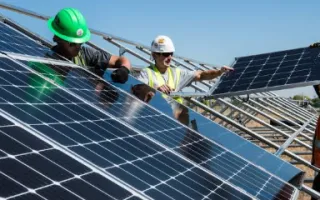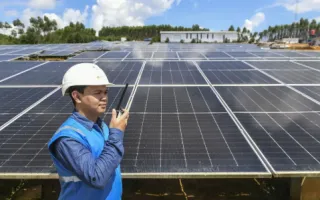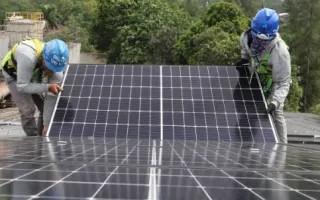
Commercial solar panels have become an increasingly important investment for businesses looking to reduce electricity expenses and improve long-term energy cost control.
Unlike residential solar projects, commercial installations can range from relatively small systems for offices and retail properties to large rooftop arrays for warehouses, factories, hotels, farms, and industrial facilities.
The larger system sizes can create significant electricity savings, but they also require a larger upfront investment.
Understanding commercial solar panel installation cost is therefore essential before a business commits to a project.
The total cost depends on system size, panel technology, inverter selection, roof condition, electrical infrastructure, labor, permitting, financing, and available incentives.
A business should evaluate the project not only by its installation price but also by its expected energy savings, payback period, financing structure, and long-term return on investment.
How Much Does Commercial Solar Installation Cost in 2026?
Commercial solar systems are usually priced according to system size, although the final installed price can vary significantly.
For preliminary planning, businesses may encounter broad cost ranges such as:
| Commercial System Size | Estimated Installed Cost |
|---|---|
| 25 kW | $40,000–$75,000 |
| 50 kW | $70,000–$130,000 |
| 100 kW | $120,000–$220,000 |
| 250 kW | $275,000–$500,000 |
| 500 kW | $500,000–$900,000 |
| 1 MW | $900,000–$1.6 million+ |
These figures are general planning estimates rather than fixed market prices.
Actual costs depend on location, equipment, labor, roof conditions, electrical infrastructure, project complexity, financing, and applicable incentives.
Larger projects may achieve lower costs per watt because engineering, permitting, mobilization, and other project expenses can be distributed across more solar capacity.
What Is Included in Commercial Solar Installation Cost?
A commercial solar quote can contain many different components.
Typical project costs include:
- Solar panels
- Inverters
- Mounting systems
- Electrical equipment
- Wiring and cabling
- Engineering
- Labor
- Structural assessment
- Roof preparation
- Permits
- Inspection
- Monitoring equipment
- Interconnection work
- Project management
- Commissioning
The cheapest equipment quote is not necessarily the cheapest complete project.
Businesses should compare total installed cost and expected energy production rather than comparing panel prices alone.
Major Factors That Affect Commercial Solar Pricing
System Size
System size is one of the biggest cost drivers.
A 500 kW installation requires substantially more equipment and labor than a 50 kW project.
However, larger systems can sometimes achieve lower costs per watt because certain fixed expenses do not increase proportionally with system size.
Roof Condition
Commercial rooftop solar projects require a suitable roof.
If the roof needs replacement soon, installing solar first can create additional complications.
Businesses may need to budget for:
- Roof repairs
- Reinforcement
- Waterproofing
- Structural upgrades
- Removal of existing equipment
Roof preparation can materially change the final project cost.
Electrical Infrastructure
A commercial solar system must integrate with the property's electrical infrastructure.
Some buildings may require:
- Electrical panel upgrades
- Transformers
- Switchgear
- New distribution equipment
- Additional wiring
- Utility interconnection work
These costs can be substantial for larger systems.
Labor and Local Regulations
Commercial solar installations require qualified professionals, engineering, permitting, inspection, and utility coordination.
Labor costs vary significantly between regions.
Local building codes and electrical requirements can also influence project timelines and pricing.
Commercial Solar Cost Per Watt
Cost per watt is commonly used to compare commercial solar projects.
Suppose a business receives this quote:
System size: 100 kW
Installed price: $160,000
Convert the system size:
100 kW = 100,000 watts
Cost per watt:
$160,000 ÷ 100,000 = $1.60/W
Now consider another project:
250 kW
Installed cost: $350,000
Cost per watt:
$350,000 ÷ 250,000 = $1.40/W
The larger project has a lower cost per watt.
However, businesses should also compare expected annual electricity production, equipment quality, warranty coverage, and operating costs.
Example Commercial Solar Installation Cost Calculation
Consider a business with a warehouse that receives a quote for a 250 kW solar system.
Estimated costs:
| Project Component | Estimated Cost |
| Solar panels | $125,000 |
| Inverters | $50,000 |
| Mounting equipment | $40,000 |
| Electrical equipment | $35,000 |
| Labor | $90,000 |
| Engineering & permitting | $25,000 |
| Other project costs | $15,000 |
| Total | $380,000 |
The total project investment is:
$380,000
System size:
250 kW
Cost per watt:
$380,000 ÷ 250,000 = $1.52/W
This gives the business a useful benchmark for comparing competing proposals.
How Much Can Commercial Solar Save a Business?
The savings depend on electricity consumption and local electricity rates.
Suppose a commercial solar system generates:
300,000 kWh per year
The business currently pays:
$0.18/kWh
Potential annual electricity value:
300,000 × $0.18 = $54,000
If the solar system costs:
$380,000
Simple payback:
$380,000 ÷ $54,000 = 7.04 years
The simplified payback is approximately 7 years.
This calculation does not include financing costs, maintenance, degradation, taxes, incentives, demand charges, or changes in electricity prices.
A professional financial model should include these factors.
Commercial Solar ROI and Payback Period
Businesses should evaluate solar as a long-term capital investment.
Important metrics include:
Simple payback period
Return on investment (ROI)
Net present value (NPV)
Internal rate of return (IRR)
Simple payback is easy to understand, but it does not account for the time value of money.
A business considering a large solar investment may therefore benefit from evaluating NPV and IRR alongside the payback period.
Example of Commercial Solar ROI
Suppose:
Initial investment: $400,000
Average annual net savings: $60,000
After five years:
$60,000 × 5 = $300,000
The project has recovered approximately 75% of its initial investment through net savings.
If annual savings increase because utility electricity prices rise, the long-term return could become stronger.
Commercial Solar Financing Options
Businesses do not necessarily need to pay the entire installation cost in cash.
Common financing structures include:
Commercial Solar Loans
A business borrows money to purchase and install the system.
The company owns the solar equipment and generally makes scheduled loan payments.
Equipment Financing
Solar equipment can be financed as a business asset.
This can preserve working capital while allowing the company to invest in energy infrastructure.
Solar Lease
Under a lease arrangement, a third party may own the equipment while the business makes regular payments.
Power Purchase Agreement
Under a PPA structure, a third-party provider owns the solar system and sells electricity generated by the system to the business under agreed contractual terms.
Each structure has different implications for:
- Ownership
- Tax treatment
- Cash flow
- Maintenance
- Contract length
- Asset value
- Long-term savings
Businesses should compare the total contractual cost rather than focusing only on monthly payments.
Commercial Solar Tax Incentives and Financial Benefits
Government incentives can significantly affect commercial solar economics.
Depending on the country and project structure, businesses may have access to:
- Tax credits
- Accelerated depreciation
- Investment incentives
- Grants
- Rebates
- Renewable energy certificates
- Clean-energy programs
The actual eligibility depends on the business, location, ownership structure, system type, and current regulations.
In the United States, federal clean-energy incentives can play a significant role in commercial project economics, while individual states may offer additional programs.
Businesses should calculate the project both before and after applicable incentives to understand the true investment.
Commercial Solar Battery Storage
Some businesses may benefit from adding battery storage.
A commercial battery can potentially help with:
- Peak demand management
- Energy arbitrage
- Backup power
- Solar self-consumption
- Grid services
- Load management
However, batteries add additional capital costs.
Businesses should first determine whether battery storage solves a specific operational or financial problem.
For a company with significant demand charges, battery storage may have additional value beyond solar energy savings.
Commercial Solar for Different Types of Businesses
Warehouses
Warehouses often have large roof areas that can support substantial solar arrays.
Daytime electricity consumption from lighting, refrigeration, HVAC, and equipment can make rooftop solar particularly relevant.
Manufacturing Facilities
Manufacturing businesses may have high electricity demand and long operating hours.
Solar can potentially offset a significant portion of daytime consumption.
Electrical infrastructure and production schedules must be considered during system design.
Retail Stores
Retail properties may benefit from solar where substantial daytime electricity consumption comes from lighting, cooling, refrigeration, and other equipment.
Hotels
Hotels can have electricity demand throughout the day and night.
Solar can reduce daytime energy purchases, while battery storage may provide additional flexibility where appropriate.
Agricultural Businesses
Farms and agricultural facilities can have substantial electricity requirements for pumps, irrigation, refrigeration, and processing equipment.
Solar may be particularly valuable when electricity consumption aligns with daylight hours.
Commercial Solar in the United States
Commercial solar economics vary considerably by state.
California
California businesses can face relatively high electricity costs and demand-related charges.
Solar and energy storage may therefore be evaluated together for certain commercial properties.
Texas
Texas offers strong solar resources in many areas.
Businesses should examine electricity contracts, utility structures, export arrangements, and project interconnection requirements.
Florida
Commercial properties can benefit from strong solar exposure, while businesses should carefully evaluate roof condition, weather resilience, insurance, and installation requirements.
New York
Businesses should evaluate available state and utility incentives, electricity rates, and project-specific financial programs.
Commercial Solar in the United Kingdom
UK businesses should evaluate:
- Electricity purchase rates
- Business energy contracts
- Solar generation
- Export compensation
- Roof suitability
- Installation costs
- Financing
Businesses that consume significant electricity during daylight hours may be able to maximize the value of rooftop solar by using more of the generated electricity directly.
Commercial Solar in Canada
Canadian commercial solar projects vary by province.
Businesses should evaluate:
- Provincial incentives
- Electricity rates
- Solar resource
- Climate
- Snow loading
- Roof conditions
- Electrical requirements
Cold climates can require additional attention to structural design and equipment specifications.
Commercial Solar in the Netherlands
Commercial solar remains relevant for businesses with suitable rooftops, but grid congestion can be an important project consideration in some areas.
Businesses should evaluate available grid capacity before finalizing a project.
Large commercial systems may also require careful consideration of self-consumption, export limitations, energy contracts, and future electricity costs.
Commercial Solar in Australia
Australia's strong solar resource makes commercial rooftop solar attractive for many businesses.
Commercial properties such as warehouses, farms, factories, and retail facilities can have large roof areas and substantial daytime electricity demand.
Businesses should evaluate:
- Solar production
- Electricity rates
- Export arrangements
- System size
- Roof structure
- Financing
- Battery storage
The economics can be particularly compelling when the business consumes a large proportion of the solar electricity on-site.
How to Reduce Commercial Solar Installation Costs
Conduct a Detailed Energy Audit
Analyze at least 12 months of electricity consumption.
Identify:
- Annual kWh usage
- Peak demand
- Daytime consumption
- Seasonal variations
- Electricity rates
This helps prevent over-sizing or under-sizing the solar system.
Compare Multiple EPC Quotes
Request detailed proposals from several qualified commercial solar contractors.
Compare:
- Cost per watt
- Equipment
- Production estimates
- Warranty
- Labor
- Project timeline
- Monitoring
- Maintenance
Evaluate Roof Condition First
Installing solar on a roof that requires major repairs shortly afterward can create unnecessary costs.
Optimize System Size
The largest possible system is not always the most profitable system.
The ideal size should reflect electricity consumption, available roof area, grid limitations, and export economics.
Compare Financing Structures
Compare the total cost of loans, leases, PPAs, and cash purchases.
A lower monthly payment does not necessarily mean a lower overall project cost.
Consider Battery Storage Separately
Don't automatically add batteries.
Determine whether demand charges, backup requirements, or time-of-use pricing create enough value to justify the additional investment.
Common Commercial Solar Investment Mistakes
Focusing only on upfront price: The cheapest quote may not produce the best long-term return.
Ignoring roof condition: Roof repairs can become expensive after solar installation.
Overestimating energy production: Production estimates should account for shading, orientation, weather, and system losses.
Ignoring demand charges: For some businesses, demand charges can materially affect the economics.
Choosing the largest possible system: Bigger does not always mean more profitable.
Ignoring financing costs: Interest and contractual payments can significantly change ROI.
Failing to evaluate warranties: Commercial solar systems are long-term investments.
Ignoring future business plans: A company planning to move locations may need a different investment strategy.
FAQ
How much does commercial solar installation cost in 2026?
Commercial solar systems can range from tens of thousands of dollars for smaller projects to more than $1 million for large installations. Actual costs depend on system size, equipment, labor, roof conditions, and electrical infrastructure.
What is the average commercial solar cost per watt?
Commercial solar costs vary by project and market, but larger installations can often achieve lower costs per watt than smaller projects because fixed project expenses are distributed across more capacity.
How long does commercial solar take to pay for itself?
A simplified payback period can often fall within several years, but the actual result depends on electricity prices, system cost, energy production, incentives, financing, and business consumption.
Is commercial solar worth the investment?
It can be highly attractive for businesses with high electricity consumption, suitable roofs, favorable solar resources, and strong electricity rates. The investment should be evaluated using project-specific financial calculations.
Can businesses finance solar panels?
Yes. Businesses may use commercial solar loans, equipment financing, leases, PPAs, or cash purchases depending on their financial strategy and project structure.
Does commercial solar increase property value?
A solar installation can potentially increase the attractiveness or value of a commercial property, but the effect depends on the property, market, ownership structure, system condition, and buyer preferences.
How large should a commercial solar system be?
System size should be based on electricity consumption, roof space, solar resource, utility requirements, export conditions, and financial objectives.
Should a business install solar batteries?
Battery storage may be useful when a business has high demand charges, significant time-of-use differences, backup requirements, or excess solar generation. It should be evaluated separately from the solar panel investment.
What is the best financing option for commercial solar?
There is no universal best option. Cash purchases maximize ownership, loans preserve some flexibility while allowing ownership, and leases or PPAs can reduce upfront capital requirements.
Conclusion
Commercial solar can transform electricity from a recurring operating expense into a long-term energy investment.
However, the success of a commercial solar project depends on much more than the number of panels installed.
Businesses should evaluate:
System size + installed cost + electricity consumption + energy rates + incentives + financing + roof condition + utility requirements + long-term ROI
A 100 kW system may be ideal for one company while a 250 kW system could be more appropriate for another.
The most important goal is to match solar production with the business's actual energy consumption and financial objectives.
Before signing a commercial solar contract, businesses should obtain multiple detailed proposals, review expected annual energy production, calculate cost per watt, examine financing terms, verify warranty coverage, and model the project's payback and long-term ROI.
The right solar system can potentially reduce operating expenses for many years while improving energy cost predictability.
If your business has a large roof and substantial electricity consumption, the next step is to analyze your last 12 months of utility bills and request a site-specific commercial solar proposal. Compare the complete installed cost, projected annual savings, financing terms, and expected payback before making the investment.